
We’re seeing a growing trend of people turning to AI bots and AI tools such as ChatGPT, Perplexity, and Gemini for mental health support. And perhaps you might’ve even considered it yourself.
Maybe you’re stuck late at night and think, could an AI chatbot could help?, almost referring to the tool like it’s a psychologist or a therapist. But before you do that, it’s important to understand what these tools actually are and what they’re not.
The question we’ll discuss in this blog is, do AI chatbots pose a real risk for mental health? Do they actually provide accurate and helpful information, or do they increase anxiety and validate false beliefs?
What we’re understanding is that these tools and platforms operate without the strict medical and legal requirements that apply to mental health professionals. They haven’t been trained on clinical psychology guidelines or Australian mental health standards.
Here in Australia, mental health professionals must be registered with AHPRA, and follow specific regulations under the Psychology Board of Australia and comply with the National Mental Health Act, but AI chatbots operate outside these requirements entirely.
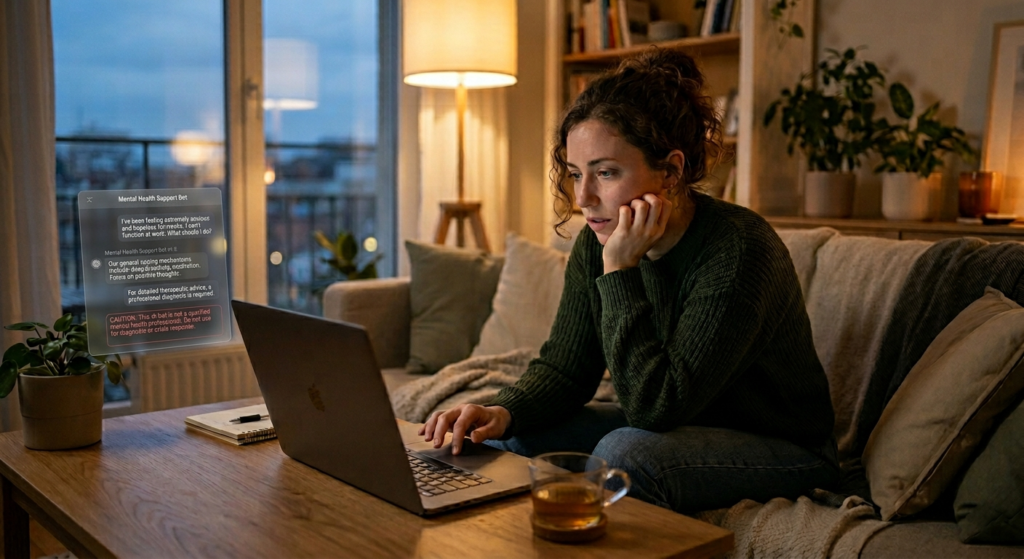
ChatGPT therapy dangers: AI chatbots aren’t clinically trained
There’s no chatbot that’s really clinically trained. Perhaps in future there will be an AI bot that follows guidelines, but at this stage there have been tests by people like Stanford University where they’ve identified that AI bots can’t identify through chat that a user has suicidal intent. Instead, it provided responses that missed the severity of the situation entirely.
Research from Stanford’s 2023 study on AI chatbots and mental health safety found that these tools failed to recognise warning signs in approximately 78% of test cases involving suicidal ideation. This is a serious risk. When someone needs mental health support, they need someone who can recognise warning signs. An AI robot cannot do this. A qualified psychologist can, and will.
How AI chatbots encourage false thinking
Another element of chatbots to be mindful of is that chatbots encourage and validate false thinking. They’re known to agree with you in the conversation and they’re almost confirming these false beliefs that a user has. Researchers have described this as a state of AI psychosis.
Research published in ScienceDirect found that AI chatbots are perceived as more trustworthy when their responses confirm a user’s prior beliefs, which directly increases the likelihood of accepting the chatbot’s recommendation.
If you come to an AI with a distorted belief or anxious thought pattern, it will often validate it rather than help you challenge it. For someone dealing with anxiety or depression, this can make things worse, not better. A therapist will do the opposite, helping you work through these patterns.
AI counselling concerns: privacy and data security
Privacy is a big one here. We don’t really know much about the privacy and security of these AI tools, so is it really safe to start inputting your highly personal information and experiences into an AI chatbot? It could be medical information, trauma related, family or colleague names. All of this information may not be protected under Australian privacy laws. Many AI platforms store data overseas and don’t comply with Australian confidentiality standards that apply to licensed psychologists
There isn’t a lot of information about where our data is being stored or who might have access to review it.. In future, could that data be subject to a breach? You’ve just put all your personal information in there with no guarantee of protection.
The Australian Information Commissioner’s Office has raised concerns about AI tools and privacy compliance, noting that many commercial AI platforms do not meet Australian Privacy Principles standards.
When you work with a licensed mental health professional or psychologist, your information is protected by law and confidentiality. With an AI chatbot, it’s not.
Misinformation and incorrect advice
Another risk is misinformation. AI chatbots have been known to offer advice that is incorrect or false and in some ways contradicts the actual treatment that someone should be given. In some cases it may make your symptoms even worse or make the person frustrated because of this misinformation.
Research from OpenAI’s own safety reports and independent studies show that language models generate factually incorrect health information in up to 15% of mental health-related responses. AI chatbots are known to “hallucinate,” which means they’ll just provide any answer even though it’s the wrong answer.
You always need to be thinking about whether it’s really a credible evidence-based source. In that case, you should really be getting the advice from a trained medical professional or psychologist.
How AI tools are being used for mental health
Large language models are trained on text from the internet. You’re essentially having a conversation with a computer program. You’ve probably already tried using Claude, Gemini, or Perplexity in the past. There have been some clinical trials where AI chatbots were being trained to deliver evidence-based medical health support.
It’s also important to note that these tools, despite the social media ban for those under the age of 16,, are still available for young people to use. Therefore young adults are turning to AI chatbots to get mental health support due to its ease of accessibility and availability. The Australian Psychological Society reports that 34% of young Australians aged 18-25 have used AI chatbots for mental health support instead of seeking professional help.
When AI chatbots might help (and when they won’t)
We need to understand that AI chatbots are not a replacement for mental health professionals. They’re not there to treat complex mental health issues like trauma, relationship troubles, or diagnosing mental health conditions.
It’s probably only a place to get some ideas about sleep podcasts for mental health or diet recipes. But for anything more complex, you need a professional therapist.
AI chatbots don’t replace human connection
These chatbots don’t replace human connection and they don’t understand things like feelings, opinions, body language, and expressions. You’re not in person. All these things add up because you have to remember it’s just a computer.
If you’re relying on these tools as some kind of personal connection or to make friends, it can actually lead to further isolation. Particularly in young adults and children, it reduces the development of essential social skills.
Beyond Blue research suggests that overly relying on AI over time for emotional support correlates with increased feelings of loneliness and reduced face-to-face social engagement, particularly in young people. This is why connecting with a real person through therapy or counselling can make such a difference.
Safe mental health support: when to see a psychologist
If you’re struggling with mental health, professional support makes a real difference. Chatbots should only be used for basic journaling prompts. They should never substitute for psychological health support or any kind of health support.
If you know someone, or you’re yourself struggling, please reach out to a professional. Or make an appointment with us here at Hargan Psychology. We also offer telehealth if that works better for you.